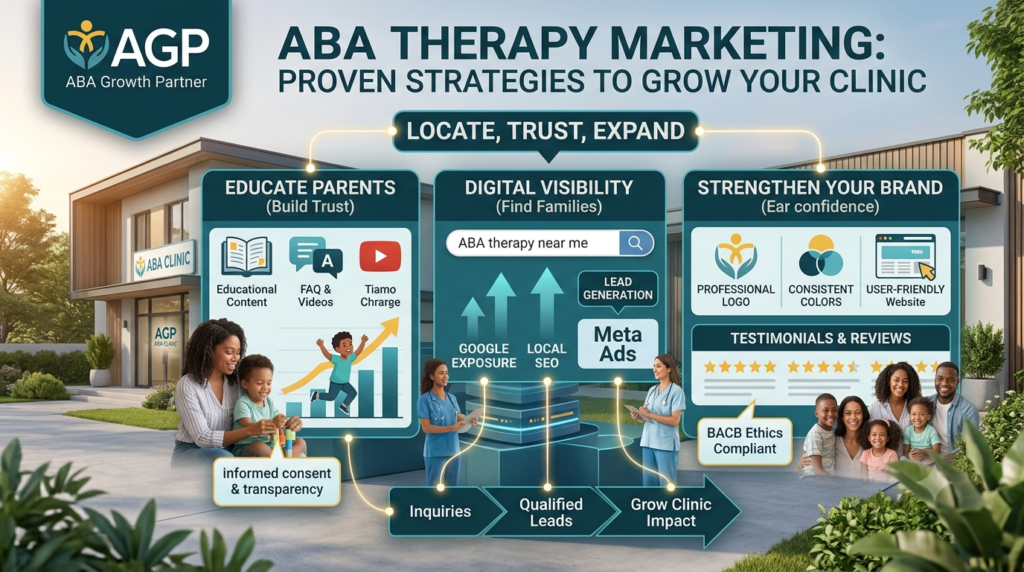
Building an ABA clinic is more than simply driving traffic to your website. Your clinic needs to generate leads from families who live in your service region, need your services, meet your intake criteria, and are ready to start the enrollment process. And that’s where a well-executed Google Ads campaign for ABA providers can really make a difference.
With Google Search campaigns businesses may show advertising to those who are searching for items or services that are relevant For an ABA clinic, this is a chance to connect with parents and caregivers at the very moment they are investigating autism therapy, reviewing insurance possibilities, or searching for a nearby provider.
But, to advertise your ABA clinic effectively, you need more than a few keywords and an increased daily budget. It involves precise location targeting, planned campaign architecture, compliant messaging, conversion-focused landing pages, and lead-quality tracking. This tutorial will show ABA clinic owners how to use Google Ads to generate more qualifying inquiries while wasting less ad spend.
Why Google Ads Can Work for ABA Clinic Marketing
Families searching for ABA services are often looking for specific information. Their searches may include:
- ABA therapy near me
- Autism therapy for children
- In-home ABA therapy
- Center-based ABA therapy
- ABA therapy that accepts insurance
- Early intervention autism services
- ABA clinic in a specific city
- ABA provider accepting new clients
Search advertising will put your clinic in front of a potential client when they search for terms connected to your services. Google also has geographic targeting, which can restrict campaigns to specific nations, states, cities, ZIP codes, or other eligible places. This combination of keyword and location targeting makes Google Ads for aba clinic an especially valuable tool for clinics with well-defined service areas.
Google Ads may help an ABA clinic:
- Increase visibility in competitive local markets.
- Promote newly opened locations.
- Fill available assessment or treatment capacity.
- Generate calls and intake form submissions.
- Reach families searching for specific service models.
- Support expansion into new cities or counties.
- Promote center-based, home-based, school-based, or telehealth services where appropriate.
The objective should not be to generate the largest possible number of form submissions. The objective should be to produce inquiries that have a realistic chance of becoming completed assessments and enrolled clients.
What Is a Qualified Lead for an ABA Clinic?
Not every click, phone call, or form submission is equally valuable.
Aba lead Generation will usually meet several of the clinic’s essential intake requirements. Depending on your services, this may include:
- Living within the clinic’s service area.
- Seeking a service your clinic currently provides.
- Meeting the clinic’s age or program requirements.
- Having an accepted insurance plan or payment method.
- Looking for an appropriate level of care.
- Being prepared to complete the intake process.
- Contact the clinic when treatment capacity is available.
Your campaign should therefore be optimized around more than a generic “contact form submitted” conversion.
A stronger measurement system distinguishes between:
- Website inquiries.
- Completed intake conversations.
- Insurance-eligible prospects.
- Scheduled assessments.
- Enrolled clients.
This allows an ABA clinic marketing team to identify which campaigns, search terms, locations, and landing pages are producing actual opportunities—not merely inexpensive leads.
Best Google Ads Strategy for an ABA Clinic
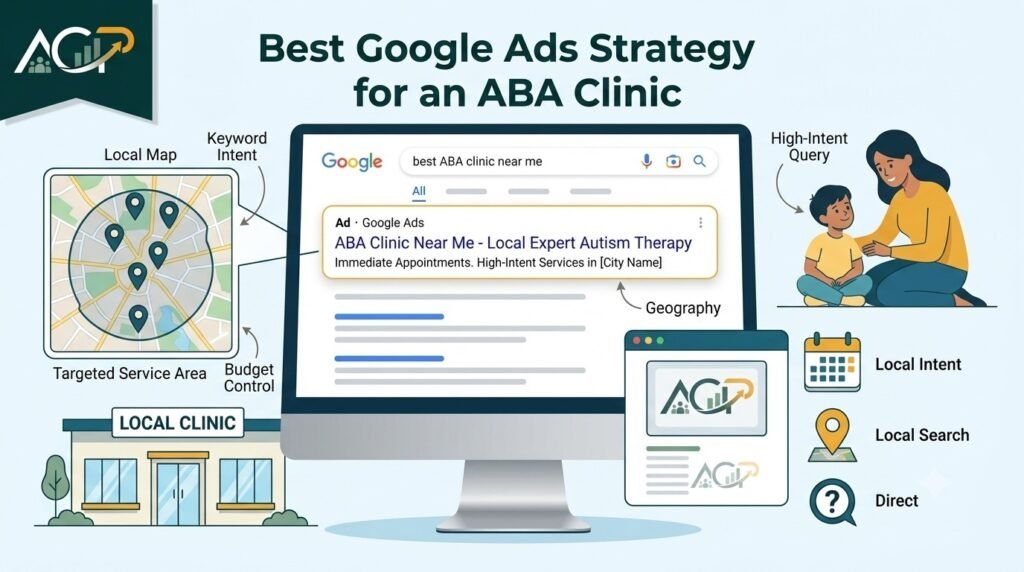
The most effective Google Ads strategy for an ABA clinic is generally a targeted Search campaign targeting local, high-intent service queries.
Broad national awareness campaigns may create impressions, but most clinics need queries from families in specific service areas. When you run a hyper-local campaign, you’ll often have more control over keyword intent, geography, messaging, and budget spend.
1. Separate Campaigns by Location
Each clinic location or major service area should have its own campaign when budget and search volume allow.
Separating locations makes it easier to:
- Control spending by market.
- Write locally relevant advertisements.
- send visitors to the correct location page.
- Compare cost per qualified lead.
- Pause campaigns for locations with limited capacity.
- Expand successful markets without increasing every campaign’s budget.
You’ll want to keep a close eye on Google’s advanced location settings. By default, the platform’s location behavior might include users who are physically located in an area as well as people who have indicated an interest in that region. Advertisers can alter these options for a more specific geographic targeting.
In most local ABA campaigns, the account manager should decide whether to target people who are physically present in the service area, rather than everyone who has indicated interest in the service region.
2. Organize Ad Groups by Service Intent
Avoid placing every keyword inside one large ad group.
Instead, separate keywords according to the service or intention behind the search.
| Ad Group | Example Search Intent | Recommended Landing Page |
| General ABA therapy | Family searching for an ABA provider | Main ABA therapy page |
| ABA therapy near me | Family looking for a local clinic | Local clinic location page |
| In-home ABA | Family interested in home-based services | In-home ABA service page |
| Center-based ABA | Family researching clinic-based care | Center-based service page |
| Early intervention | Family seeking services for a young child | Early intervention page |
| Insurance and funding | Family checking coverage options | Insurance information page |
| Specific city searches | Family searching within one market | City-specific location page |
This structure improves the relationship between the search, advertisement, and landing page.
A person searching for in-home ABA therapy should see an advertisement about in-home services and arrive on a page explaining how those services work. Sending every visitor to the homepage can introduce unnecessary steps and reduce the likelihood of an inquiry.
3. Start With High-Intent Keywords
High-intent keywords indicate that the searcher may be actively looking for a provider.
Examples include:
- ABA clinic near me
- ABA therapy near me
- Autism therapy near me
- ABA providers in USA
- ABA therapy accepting new clients
- In-home ABA therapy Miami
- Pediatric ABA clinic
- Early intervention ABA services
While informational searches such as “what is ABA therapy” might still be beneficial for content marketing, they don’t always mean the consumer is ready to contact a clinic.
At the start of a campaign, use a blend of exact-match and phrase-match keywords. Once you have reliable conversion tracking on the account and enough data on qualified leads to assist improvement, you may explore broader matching.
Google Keyword Planner gives keyword ideas and estimations of searches and cost per click, and you may filter results by area.
Google Ads Campaign Types for ABA Providers
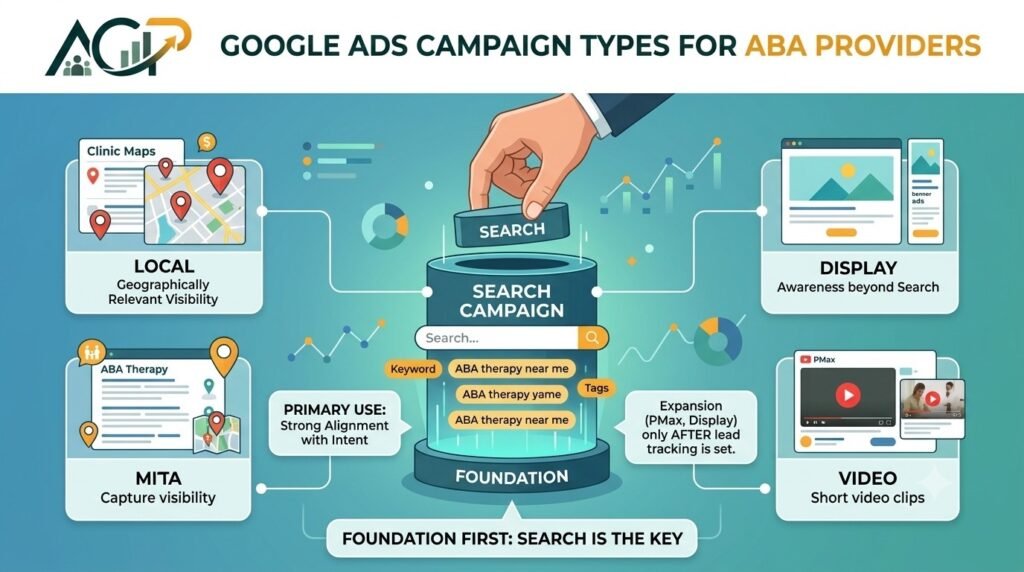
Not every campaign type has the same purpose.
| Campaign Type | Primary Use | Potential Advantage | Important Consideration |
| Search campaign | Capture active service searches | Strong alignment with high-intent keywords | Requires search-term and negative-keyword management |
| Call-focused Search campaign | Encourage phone inquiries | Useful for clinics with responsive intake teams | Call quality and duration must be tracked |
| Local or location-focused campaign | Promote clinic locations | Supports geographically relevant visibility | Location settings must be reviewed carefully |
| Performance Max | Expand across Google inventory | Can identify additional conversion opportunities | Requires strong conversion data and less keyword-level control |
| Display campaign | Awareness and selected contextual outreach | Visual reach beyond Search | Health-related audience restrictions must be considered |
| Remarketing | Re-engage previous visitors | Often useful in other industries | Sensitive-health personalization rules may restrict its use |
For many clinics, Search should be the foundation of the account because it reaches people actively researching services. Expansion into other campaign types should occur only after lead tracking, privacy review, and intake feedback are in place.
Track Calls, Forms, and Qualified Intakes
Google Ads can track calls generated from advertisements or from a phone number displayed on a website. Call conversion settings can also use minimum call duration to help distinguish brief calls from potentially meaningful inquiries. However, call duration alone does not establish lead quality.
An ABA clinic should ideally measure:
| Conversion Stage | What It Measures |
| Contact form submission | Initial website inquiry |
| Phone call | Caller contacted the clinic |
| Qualified intake conversation | Prospect met initial service criteria |
| Benefits verification started | Insurance information entered the verification process |
| Assessment scheduled | Prospect completed a meaningful intake step |
| Client enrolled | Inquiry became an active client |
When technically and legally appropriate, qualified outcomes can be reported back to the advertising platform. This gives optimization systems better information than counting every call or form as equally valuable.
Google uses conversion data for reporting and as an input into automated strategies such as Target CPA. Smart Bidding relies on conversion tracking to optimize bids during individual auctions.
For this reason, inaccurate conversion tracking can lead to inaccurate optimization.
How to Plan a Google Ads Budget
There is no universal Google Ads budget that is appropriate for every ABA clinic.
The right budget depends on:
- Geographic market.
- Number of clinic locations.
- Search demand.
- Competition.
- Cost per click.
- Treatment capacity.
- Insurance relationships.
- Website conversion rate.
- Intake-team response time.
- Target number of new clients.
- Acceptable cost per qualified lead.
Google notes that campaign performance and keyword costs can be influenced by factors including bids, budget, ad quality, location targeting, customer behavior, and industry conditions.
A Practical Budget Formula
Instead of selecting an arbitrary amount, work backward from the clinic’s growth objective.
Monthly lead target × acceptable cost per qualified lead = estimated monthly advertising budget
For example:
- Desired qualified inquiries: 20 per month
- Planning cost per qualified inquiry: $150
- Example media budget: 20 × $150 = $3,000 per month
This is a planning example, not a guaranteed cost.
The clinic would still need to consider:
- Advertising management fees.
- Landing-page development.
- Call-tracking or CRM costs.
- Website improvements.
- Creative production.
- Privacy and compliance review.
Budget for Google Ads in the US
The budget for Google Ads in the US can vary significantly between states, cities, and service areas. A clinic in a highly competitive metropolitan market may need a different budget from a provider serving a smaller regional market.
The campaign should have enough funding to collect meaningful data without exposing the clinic to uncontrolled spending.
A phased approach may include:
| Stage | Primary Objective | Budget Approach |
| Initial launch | Test keywords, advertisements, locations, and landing pages | Concentrate spending on the highest-intent services |
| Validation | Identify qualified lead sources | Shift spending away from irrelevant searches and weak locations |
| Growth | Increase qualified inquiries | Expand winning campaigns and service areas gradually |
| Multi-location expansion | Allocate leads by clinic capacity | Set separate budgets and goals for each location |
A small budget spread across too many cities, services, and campaign types may produce insufficient data in every category. It is often more effective to fully support a focused campaign before expanding.
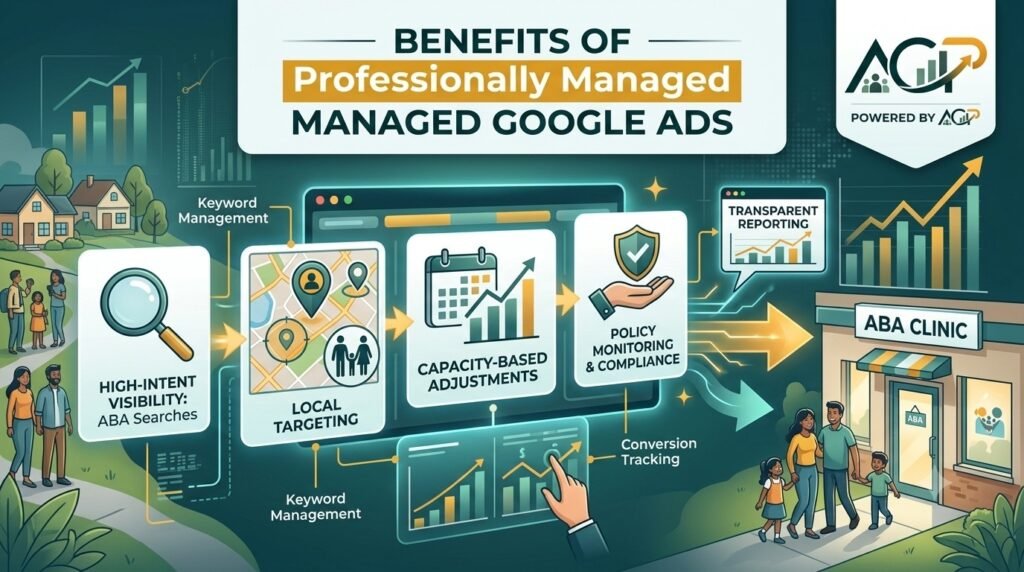
Benefits of Professionally Managed Google Ads
| Benefit | Value for an ABA Clinic |
| High-intent visibility | Reaches people actively searching for ABA services |
| Local targeting | Focuses advertising on eligible service areas |
| Budget control | Establishes spending limits by campaign or location |
| Keyword management | Prioritizes commercially relevant searches |
| Negative keywords | Reduces spending on jobs, training, and unrelated research |
| Conversion tracking | Connects advertising activity to calls and forms |
| Lead-quality optimization | Prioritizes qualified intake opportunities |
| Location-level reporting | Shows which clinics and markets generate results |
| Landing-page testing | Improves the path from search to inquiry |
| Capacity-based adjustments | Redirects spending according to availability |
| Policy monitoring | Helps identify Google Ads compliance risks |
| Transparent reporting | Connects media spending with clinic growth goals |
Google Ads Near Me or a Specialized ABA Marketing Partner?
Clinic owners frequently search for phrases such as Google Ads Near Me when they want local marketing support. Physical proximity can be useful, but healthcare advertising experience may be more important than the agency’s office location.
When evaluating a provider, ask whether the agency understands:
- ABA clinic intake workflows.
- Insurance verification processes.
- Multi-location campaign structures.
- Sensitive-health advertising restrictions.
- Healthcare landing-page requirements.
- Qualified lead tracking.
- Call tracking and intake attribution.
- Capacity-based budget management.
- Privacy considerations for healthcare websites.
A general local agency may understand the market but lack ABA experience. A specialized Google Ads USA partner may work remotely while offering deeper knowledge of autism therapy advertising and multi-state clinic growth.
The best choice is the provider that can demonstrate a clear process for generating, qualifying, and reporting ABA inquiries—not simply increasing clicks.
Generate More Qualified ABA Inquiries
A successful Google Ads campaign for ABA providers is not built around traffic alone. It connects search intent, location, clinic capacity, landing-page experience, intake performance, and privacy-conscious measurement.
The strongest campaigns typically include:
- High-intent local keywords.
- Separate campaigns for important locations.
- Service-specific advertisements and landing pages.
- Consistent negative-keyword management.
- Accurate call and form tracking.
- Qualified intake reporting.
- Capacity-based budget adjustments.
- Careful healthcare policy review.
When these elements work together, Google Ads can become a structured client-acquisition channel rather than an unpredictable monthly expense.
Looking for Professional ABA Clinic Advertising Services?
Aba Growth Partner Google Ads services help ABA Clinics build location-focused campaigns designed around qualified inquiries not vanity metrics.
We can help your clinic:
- Identify high-intent search opportunities.
- Build campaigns for individual locations and services.
- Reduce irrelevant clicks.
- Improve ABA landing pages.
- Track meaningful calls and intake requests.
- Align advertising budgets with clinic capacity.
- Create transparent performance reports.
ABA Growth Partner is a digital marketing agency with a focus on helping ABA therapy clinics grow through data-driven digital marketing methods that generate measurable outcomes. Our staff builds tailored solutions to maximize your advertising budget and drive more patient inquiries through Google Ads campaign management, lead generation, SEO, website optimization, and local marketing to attract qualified families.
Learn more about our mission and skills on our About Us page. If you are ready to build your ABA clinic or have questions about what we have to offer, please visit our Contact Us page. Our staff is here to help you build a marketing strategy to get your clinic in front of more people that need your services.
Conclusion
Driving successful Google Ads for ABA Clinics needs more than just posting ads. You need a strategy, one that reaches the appropriate families at the right time. Choosing high-intent keywords, writing engaging ad text, optimizing landing pages, targeting local clients and continually monitoring the results of your campaigns will all help your clinic to produce more qualified leads and maximize the return on your advertising investment. With a solid Google Ads approach, your ABA clinic can bring in new families, fill up appointment slots, and establish a sustainable practice.
Frequently Asked Questions
Are Google Ads effective for ABA clinics?
Google Ads can support ABA clinic growth when campaigns target relevant searches, appropriate service areas, and qualified intake actions. Results depend on competition, budget, website quality, clinic capacity, tracking accuracy, and intake performance.
How much should an ABA clinic spend on Google Ads?
The appropriate Google Ads budget should be based on local search demand, target qualified leads, acceptable acquisition cost, and available treatment capacity. Begin with a focused market and expand after identifying which campaigns generate qualified opportunities.
What is the best campaign type for an ABA provider?
Search campaigns are often the most practical starting point because they reach people actively searching for ABA and autism therapy services. Other campaign types can be considered after reliable conversion and lead-quality tracking has been established.